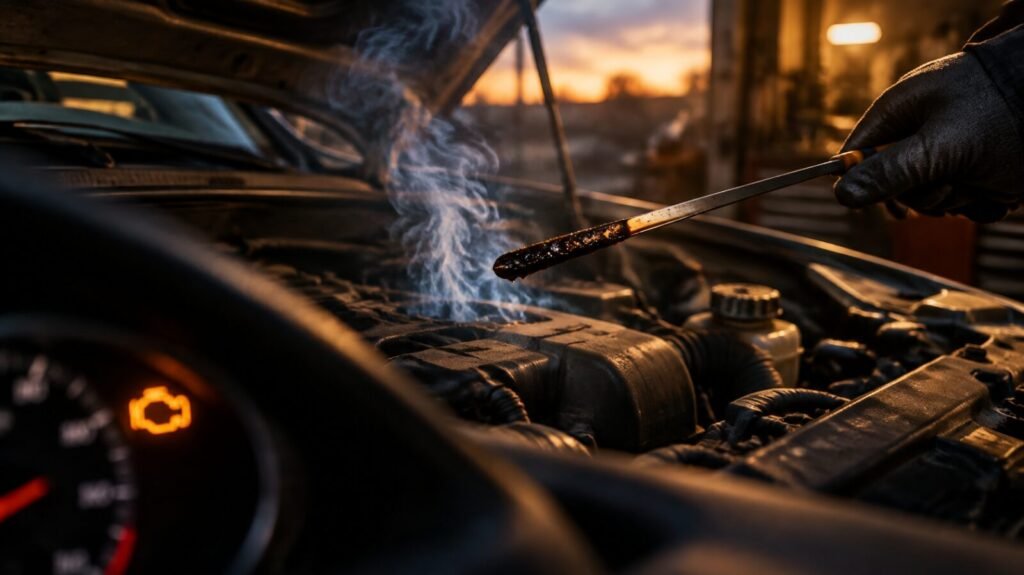
Quick answer: The most common signs of engine failure are knocking noises, a flashing check engine light, thick exhaust smoke, overheating, unexplained oil or coolant loss, milky oil, rough idling and loss of power. Knocking, a flashing check engine light, low oil pressure or overheating mean stop driving now. Continuing can turn a repairable problem into a blown engine.
Your engine rarely dies without warning. Most of the time it gives you clues for weeks, sometimes months, before it finally quits. A new noise here, a puff of smoke there, a dashboard light you keep meaning to check.
The trouble is that these clues are easy to brush off. Life is busy, the car still starts, so you keep driving. Then one morning it doesn’t start at all, and a repair that could have cost a few hundred dollars turns into a full engine replacement.
This guide walks you through the most common signs your engine is going bad, what each one usually means, and how urgent it is. By the end, you’ll know which symptoms can wait for an appointment next week and which ones mean you should pull over right now.
12 signs of engine failure you shouldn’t ignore
1. Knocking, tapping or ticking noises
A deep, rhythmic knock that gets faster as you press the gas is one of the most serious signs of engine failure. It often points to worn rod bearings, which means metal parts inside the engine are hitting each other. A lighter ticking at idle can be low oil or a noisy valve lifter.
What to do: Check the oil level first. If the knock is deep and loud, stop driving. A spun rod bearing can break a connecting rod, and that usually ends the engine.
2. Check engine light comes on (or starts flashing)
A steady check engine light means the car’s computer has spotted a problem. It could be as small as a loose gas cap or as big as a failing sensor. A flashing light is different. It usually means a severe misfire that can overheat and damage the catalytic converter.
What to do: Get the code read with an OBD-II scanner. Many auto parts stores do this for free. If the light is flashing, reduce speed and get off the road as soon as it’s safe.
3. Smoke from the exhaust
The color of the smoke tells you a lot:
- Blue or gray smoke: The engine is burning oil. Worn piston rings or valve seals are common causes.
- Thick white smoke (that doesn’t go away after warm-up): Coolant is getting into the combustion chamber. This often means a blown head gasket or a cracked cylinder head.
- Black smoke: The engine is burning too much fuel. Common causes are a clogged air filter, leaking injectors or a faulty sensor.
Thin white vapor on a cold morning that disappears in a few minutes is normal condensation, not a warning sign.
4. Engine overheating
If the temperature gauge climbs into the red, or steam comes from under the hood, the engine is in danger. Heat warps the cylinder head, blows the head gasket and can seize the engine completely. Causes include low coolant, a failed water pump, a stuck thermostat or a leaking radiator.
What to do: Pull over and turn the engine off. Never open a hot radiator cap. Let it cool fully before checking the coolant.
5. Losing oil or coolant with no visible leak
If you keep topping up oil or coolant but can’t find a puddle under the car, the fluid is going somewhere inside the engine. Oil that disappears is usually being burned. Coolant that disappears may be leaking into the cylinders or the oil.
What to do: Track how much you add and how often. A mechanic can run a compression test or cooling system pressure test to find the cause.
6. Milky or foamy oil
Pull the dipstick or look under the oil cap. If the oil looks like chocolate milk or has a creamy, foamy layer, coolant is mixing with it. This is a classic sign of a blown head gasket or cracked head. Oil mixed with coolant can’t protect the bearings, so damage builds fast.
What to do: Don’t keep driving on it. Get it diagnosed right away.
7. Metal shavings in the oil
Fine metal flakes or glitter in your oil during an oil change means internal parts are wearing against each other. Bearings, the camshaft or the timing components are typical sources.
What to do: Ask the shop to cut open the oil filter and check what’s inside. Heavy metal debris usually means the engine is near the end.
8. Low oil pressure warning
The red oil can light on your dash is not the same as a low oil level reminder. It means oil pressure has dropped. Without pressure, oil can’t reach the parts that need it, and the engine can be damaged in minutes.
What to do: Stop the engine as soon as it’s safe. Check the level. If the level is fine and the light stays on, have it towed.
9. Rough idle, misfires and shaking
When the car shakes at a stoplight, stumbles, or feels like it’s missing a beat, one or more cylinders isn’t firing properly. Bad spark plugs or ignition coils are the common culprits, but low compression from internal wear can cause it too.
What to do: Read the codes first. Misfire codes (P0300 to P0308) tell you which cylinder is affected. If new plugs and coils don’t fix it, ask for a compression test.
10. Loss of power, poor acceleration and worse fuel economy
If the car struggles up hills, feels slow to merge, or won’t rev the way it used to, the engine may be losing compression. Worn piston rings, burnt valves or a slipped timing belt can all rob power. A sudden drop in fuel economy often shows up at the same time, because a weak engine has to work harder for the same speed.
What to do: Note when the power loss happens (cold, hot, under load) and have a compression or leak-down test done. A slipped timing belt is urgent on many engines, so don’t put it off.
11. Stalling or hard starting
An engine that cranks for a long time before starting, or stalls at idle, may have fuel, ignition or compression problems. On its own this can be a minor fix. Combined with other signs on this list, it often points to a deeper issue.
What to do: Get the codes read and have the battery and fuel pressure checked first, since those are the cheap fixes. If the engine also knocks, smokes or burns oil, treat it as an internal problem.
12. Burning, sweet or raw-fuel smells
Your nose often catches a problem before the gauges do. Each smell points somewhere different:
- Raw fuel: A fuel leak. Treat this as a fire risk and stop driving.
- Burning oil: Oil leaking onto hot exhaust parts.
- Sweet, syrupy smell: Leaking coolant.
- Rotten eggs: A failing catalytic converter, often caused by engine misfires.
What to do: A raw-fuel smell means stop and get the car checked before driving again. For burning-oil or sweet coolant smells, look for leaks and book a check soon.
Engine failure warning signs at a glance
Use this table to judge how urgent each symptom is. When in doubt, treat it as the more serious option.
| Warning sign | Most likely cause | Can you keep driving? |
|---|---|---|
| Deep knocking that rises with RPM | Worn or spun rod bearings | No. Stop and tow |
| Flashing check engine light | Severe misfire | No. Stop as soon as safe |
| Red oil pressure light | Low oil or failed oil pump | No. Shut off engine |
| Temperature gauge in the red | Low coolant, water pump, thermostat | No. Pull over and cool down |
| Milky or foamy oil | Blown head gasket, cracked head | No. Get it diagnosed now |
| Thick white exhaust smoke | Coolant burning in cylinders | Only a short trip to a shop. Stop if it overheats or the oil turns milky |
| Metal shavings in oil | Internal wear | Short trips only, to a shop |
| Blue or gray exhaust smoke | Worn rings or valve seals | Yes, but book a check soon |
| Steady check engine light | Sensor, emissions or ignition fault | Yes, read the code this week |
| Rough idle or misfires | Plugs, coils, low compression | Yes, but get it checked soon |
| Loss of power | Compression loss, timing, fuel | Yes, with care |
| Drop in fuel economy | Sensors, injectors, internal wear | Yes, monitor and check |
What causes an engine to fail?
Most engine failures come down to a handful of causes, and most of them are preventable:
- Oil starvation: Running low on oil, skipping oil changes, or a failed oil pump. This is the number one engine killer.
- Overheating: Coolant leaks, a bad water pump or a stuck thermostat let heat warp metal parts.
- Timing belt or chain failure: On many engines, a snapped belt lets pistons hit the valves, causing major damage in seconds.
- Ignoring small problems: A misfire or minor leak left alone for months puts extra stress on the whole engine.
- Detonation (pre-ignition): Wrong fuel grade or carbon buildup makes fuel ignite too early, which can crack pistons.
- High mileage and wear: Every engine wears out eventually, especially without regular maintenance.
What to do when you notice warning signs
- Don’t ignore it. Write down what you noticed, when it happens (cold start, highway, idle) and how long it’s been going on. This helps the mechanic a lot.
- Check the basics yourself. Look at the oil level and color, coolant level, and any puddles under the car.
- Read the codes. An inexpensive OBD-II scanner or a free code read at a parts store gives you a starting point.
- Stop driving for the serious signs. Knocking, a flashing check engine light, low oil pressure and overheating all call for an immediate stop.
- Get a proper diagnosis. Ask for a compression test or leak-down test if internal damage is suspected. These show the real health of the engine.
- Get a written quote. Before approving work, know the cost of repair compared with replacement.
Repair, rebuild or replace?
Once the engine is diagnosed, you usually have three paths: repair it, rebuild it, or go for an engine replacement with a used, new or remanufactured unit. The right one depends on the damage, the car’s value and how long you plan to keep it.
| Option | Best when | Trade-off | Typical installed cost* |
|---|---|---|---|
| Repair | Damage is limited (gasket, sensor, water pump, ignition parts) | Cheapest, but won’t fix an engine that’s worn out inside | Depends on the part; usually far less than replacement |
| Rebuild | Block is sound and you want the original engine | Labor-heavy and can take weeks | About $3,000 to $7,000 |
| Used engine replacement | Major internal damage, but the rest of the car is in good shape | Often the most cost-effective fix for a car worth keeping | About $1,500 to $4,000 |
| New or remanufactured engine | You want maximum lifespan and warranty | Highest cost | About $4,000 to $10,000+ |
Ballpark 2026 US ranges including labor, based on UseCalcPro’s engine swap cost data. Your actual quote depends on the vehicle, engine size and local labor rates.
A common rule of thumb: if the repair costs more than about half of what the car is worth, compare it against a replacement engine before deciding.
Facing a replacement? KM Pathway supplies tested used engines for most US makes and models, backed by a 90-day warranty, free shipping to the lower 48 states and 30-day returns. Get a free engine quote or call (888) 928-5882.
Tips for buying a used engine
- Ask for the mileage and, if possible, the VIN of the donor vehicle.
- Request a compression test result or a video of the engine running.
- Confirm the exact match for your year, make, model and engine code.
- Get a written warranty and read what it covers (parts only, or parts and labor).
- Buy from a seller who offers shipping to a repair shop and clear return terms.
How to prevent engine failure
- Change the oil on schedule, using the grade your owner’s manual recommends.
- Check oil and coolant levels once a month.
- Replace the timing belt at the interval the manufacturer gives.
- Fix leaks and warning lights early, while they’re still small problems.
- Replace air and fuel filters on time.
- Let the engine warm up gently and avoid hard revving when it’s cold.
- Use the correct fuel octane for your engine.
Frequently asked questions
What are the first signs of engine failure?
The earliest signs are usually small: a new ticking or knocking sound, a check engine light, needing to top up oil more often, or a slight drop in power or fuel economy. Catching them at this stage gives you the best chance of a cheap fix.
Can an engine fail without warning?
Rarely. Most engines show symptoms first. Sudden failures usually come from a snapped timing belt, a total loss of oil, or severe overheating that the driver didn’t notice in time.
How long can I drive with a knocking engine?
Ideally, not at all. A deep rod knock can turn into a broken connecting rod at any moment. Once that happens, the engine almost always needs replacing.
Is it worth fixing a car with a failed engine?
If the body, transmission and interior are in good shape, a replacement engine is often cheaper than buying another car. A quality used engine with a warranty is a popular middle-ground choice.
Does white smoke always mean engine failure?
No. Thin white vapor on a cold start is normal condensation. Thick white smoke that keeps coming after the engine is warm, often with a sweet smell, points to coolant burning and needs prompt attention.
What does a blown engine sound like?
Common blown engine symptoms include a loud, heavy knocking or banging sound, very rough running, sudden power loss, or the engine stopping altogether. Some blown engines won’t crank at all because internal parts have seized.
The bottom line
The signs of engine failure are rarely silent. Knocking, smoke, overheating, warning lights and disappearing fluids are early warnings that something inside is wearing out. Deal with them early and you may only need a small repair. Ignore them and you could be looking at a full replacement.
If your engine is already past saving, a tested used engine from KM Pathway is one of the most affordable ways to get your car back on the road. Every engine comes with a 90-day warranty, free shipping to the lower 48 states and 30-day returns. Call (888) 928-5882 or use the quote form on this page.
References
- Rod Knock Symptoms and Causes — RealTruck
- White, Blue or Black: What Is My Exhaust Color Telling Me? — Firestone Complete Auto Care
- What Causes White, Blue, Black, or Gray Exhaust Smoke? — CJ Pony Parts
- Here’s What Different Colors of Exhaust Smoke Mean — SlashGear
- What Causes Engine Knocking and How Do You Fix It? — SlashGear
- Engine Swap Cost in 2026: Used, Rebuilt, Reman & Crate Pricing — UseCalcPro
- How Much Does an Engine Replacement Cost in 2026? — CoverageX
Pingback: Check Engine Light Flashing: Is It Safe to Drive? (2026)
Pingback: Winter Is Coming: How Cold Weather Finishes Off Weak Engines and Transmissions