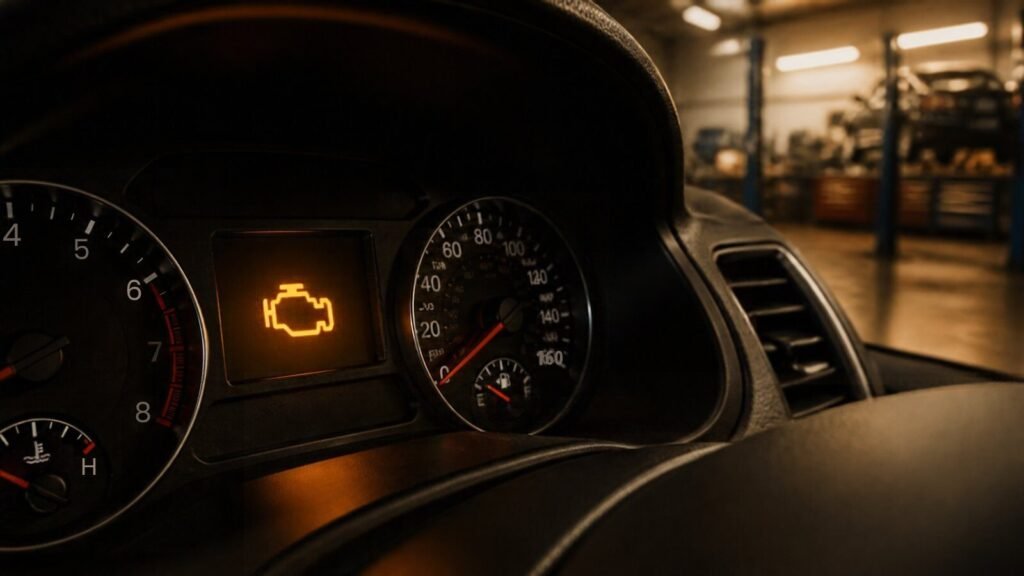
A check engine light flashing means your engine is misfiring badly enough to damage the catalytic converter. It is not safe to keep driving normally. Ease off the gas, avoid hard acceleration, and get off the road as soon as you safely can. If the car shakes, stalls or smells like burning, pull over and call a tow.
Below: why the light blinks, what usually causes it, what each fix costs in 2026, and when replacing the engine makes more sense than repairing it.
Disclosure: This guide is published by KM Pathway LLC, which sells tested used engines. Most flashing-light problems are fixed with a coil, spark plugs or an injector, not a new engine, and we say so below.
Check engine light flashing at a glance
| Question | Short answer |
|---|---|
| What does it mean? | An active, severe misfire. Unburned fuel is overheating the catalytic converter. |
| Is it safe to drive? | Not normally. Drive gently, only as far as you must to stop safely. |
| Most common causes | Bad ignition coil, worn spark plugs, stuck fuel injector, vacuum leak. |
| Codes you will usually see | P0300 (random misfire), P0301–P0308 (one cylinder), later P0420/P0430. |
| Typical fix cost | About $238–$320 for a coil or $288–$399 for plugs (RepairPal, Sept 2026). |
| Cost if you keep driving | A catalytic converter, about $2,280–$2,480 (RepairPal, Sept 2026). |
| When to think about a new engine | Only if a compression or leak-down test shows a dead cylinder. |
Check Engine Light Flashing vs Solid: What’s the Difference?
A solid light means a fault was stored and you should book a scan soon. A flashing light means a severe misfire is happening right now, so stop pushing the engine.
| Solid (steady) light | Flashing (blinking) light | |
|---|---|---|
| What it means | A fault was found. Not an emergency right now. | Active, severe misfire. Damage is happening now. |
| Common causes | Loose gas cap, O2 sensor, EVAP leak, MAF sensor | Bad coil, worn plugs, stuck injector, vacuum leak, low compression |
| Safe to drive? | Usually yes, short term. Book a scan soon. | No. Drive only as far as needed to stop safely. |
| Risk if ignored | Worse fuel economy, failed emissions test | Overheated catalytic converter, engine damage |
Solid means “get it checked.” Flashing means “stop pushing the engine.”
Many drivers miss one detail. The light can flash only under load, like climbing a hill or merging, and then go solid again at a steady cruise. That still counts as a flashing light. The misfire is real, it just shows up when the engine works harder.
Why Does the Check Engine Light Flash?
Because one or more cylinders are misfiring often enough to damage the catalytic converter. The engine computer (ECU) counts misfires and blinks the light once the rate is high enough to cause harm.
Your engine burns fuel in each cylinder in a set order. When one cylinder fails to fire, the raw fuel does not burn there. It goes out into the exhaust instead.
That unburned fuel reaches the catalytic converter and burns inside it. The converter gets much hotter than it was built for. Keep driving like that and the inside of the converter can melt or clog. Now a $250 coil problem has turned into a $2,000+ exhaust repair.
That’s why the blinking matters: the damage is happening while you drive, not later.
Which OBD-II Codes Come With a Flashing Light?
When a shop or a cheap code reader scans the car, a flashing light almost always comes with a misfire code:
- P0300: random or multiple-cylinder misfire
- P0301 to P0308: misfire in one specific cylinder (the last digit is the cylinder number, so P0304 means cylinder 4)
- P0420 / P0430: catalytic converter efficiency below threshold, which often shows up after a misfire has gone on too long
A cylinder-specific code like P0302 is good news in a way. It points to one cylinder, which usually means one coil, one plug or one injector.
What Causes a Flashing Check Engine Light?
Most of the time it’s an ignition problem: a bad coil or worn spark plugs. Injectors, vacuum leaks, low compression and timing faults are less common. Here are the seven usual causes, roughly from most to least common.
- Bad ignition coil. Coils crack and weaken with heat. On coil-on-plug engines, one bad coil gives you a single-cylinder misfire code.
- Worn or fouled spark plugs. Old plugs with a wide gap or oil fouling can’t fire under load. Plug intervals vary a lot by engine, so check your owner’s manual.
- Clogged or leaking fuel injector. A stuck injector starves or floods one cylinder.
- Vacuum leak. A split hose or a failed intake gasket lets in extra air, so the mixture runs too lean to fire properly.
- Damaged plug wire or coil boot. Common on older engines. Look for burn marks or carbon tracking.
- Low compression. A burnt valve, broken ring or blown head gasket means the cylinder can’t build pressure. Our guide to blown head gasket symptoms explains the other signs to look for.
- Timing problems. A stretched timing chain or a jumped belt throws off every cylinder at once and often triggers P0300.
A loose gas cap will not make the light flash. It can turn the light on solid, but it does not cause a misfire.
Is It Safe to Drive With a Flashing Check Engine Light?
No, not for normal driving. Drive only as far as you must to get somewhere safe, and keep the engine load light.
Use this as your decision guide:
| What you notice | What to do |
|---|---|
| Light flashing, car runs mostly smooth | Slow down, no hard acceleration, drive a short distance to a shop or home |
| Light flashing plus shaking or loss of power | Pull over safely and call a tow |
| Flashing light plus temperature gauge rising or oil light on | Shut the engine off now |
| Burning smell or glowing red under the car | Stop, turn off the engine, step away from the car, call for help |
Don’t tow a trailer, don’t climb long grades, and don’t jump on the freeway with a blinking light. Every mile under load is more heat in the converter.
What Should You Do When the Check Engine Light Starts Flashing?
Ease off the gas, check your gauges, pull over somewhere safe and get the codes read. Here are the six steps in order.
- Lift off the throttle. Lower load means fewer misfires.
- Turn off the A/C and extra loads to take some strain off the engine.
- Check your gauges. Temperature high or oil pressure low? Stop now.
- Pull over somewhere safe and let the engine idle for a moment. Does the light keep flashing at idle? That points to a constant fault, like a dead coil, a stuck injector, a vacuum leak or low compression. If it only flashes when you accelerate, look at weak coils and worn plugs first.
- Get the codes read. Many auto parts stores will scan it for free, and a basic OBD-II reader is cheap to own.
- Don’t just clear the code and drive on. Clearing it turns the light off but doesn’t fix the misfire.
How Can You Test an Ignition Coil Yourself?
Got a code for one cylinder, say P0303? On most coil-on-plug engines, you can swap the coil from cylinder 3 with the coil from cylinder 2. Clear the code and drive gently. If the code moves to P0302, the coil is bad. If it stays on P0303, look at the plug or injector next. A shop does the same thing, just faster.
How Much Does It Cost to Fix a Flashing Check Engine Light?
Most flashing-light repairs are cheap if you act fast. They get expensive when you don’t. The ranges below are national averages from RepairPal (updated September 2026) and don’t include taxes or local labor differences. We picked the three most common misfire fixes, plus the catalytic converter, because that’s the bill you risk by waiting.
| Repair | Typical total cost (USD) |
|---|---|
| Ignition coil replacement | $238 to $320 |
| Spark plug replacement | $288 to $399 |
| Fuel injector replacement | $768 to $953 |
| Catalytic converter replacement | $2,280 to $2,480 |
A coil costs a few hundred dollars. A converter costs over two thousand. Fixing the misfire early can save you around $2,000.
Expect a diagnostic fee on top. Prices vary by shop and city, and many shops credit it toward the repair.
When Does a Flashing Light Mean a Bigger Engine Problem?
Only when the misfire comes from inside the engine, not from a part you can swap. If a compression test shows a dead cylinder, you may be looking at:
- Burnt or bent valves
- Broken piston rings or a cracked piston
- A blown head gasket letting coolant into the cylinder
- Bearing damage with knocking (see our guide to engine knocking sound)
These repairs mean pulling the head or rebuilding the engine. At that point, compare the rebuild quote with a replacement. A tested used engine often costs less than a full rebuild and gets you back on the road faster. If you’re unsure, our guide to the signs of engine failure walks through the other warning signs.
Need a replacement engine? If a compression test confirms a dead cylinder, send us your VIN and we’ll match a tested used engine to it. Every unit has a 90-day warranty, ships free to the lower 48 states and can be returned within 30 days. Call (888) 928-5882 or get a free quote.
How Can You Prevent a Flashing Check Engine Light?
Keep the ignition parts fresh and fix small warnings early. Most misfires start with old plugs, tired coils or a solid light that got ignored.
- Replace spark plugs on the schedule in your owner’s manual.
- Use the fuel grade your engine calls for.
- Fix a solid check engine light quickly, before it becomes a misfire.
- Replace cracked vacuum hoses and coil boots when you see them.
- Keep up with oil changes. Sludge and low oil can lead to timing and compression problems.
Check Engine Light Terms Explained
Misfire: A cylinder fails to burn its fuel on a power stroke. The engine shakes or loses power, and raw fuel goes into the exhaust.
ECU (engine control unit): The engine’s computer. It watches crankshaft speed to count misfires and decides when to flash the light.
OBD-II: The standard diagnostic system on US cars since 1996. A scanner plugs into the port under the dash to read codes.
P0300 / P0301–P0308: Misfire codes. P0300 means random or multiple cylinders; the last digit of P0301–P0308 is the cylinder number.
Catalytic converter: The exhaust part that cleans emissions. Unburned fuel from a misfire overheats it and can melt its core.
Ignition coil (coil-on-plug): Turns battery voltage into the high voltage a spark plug needs. Coil-on-plug engines have one coil per cylinder.
Compression test: Measures how much pressure each cylinder builds. A low reading points to valve, ring or head gasket damage.
Leak-down test: Pressurizes a cylinder to show where the air escapes: intake, exhaust, crankcase or cooling system.
Frequently Asked Questions
Is it safe to drive with the check engine light flashing?
No, not for normal driving. A flashing light means an active misfire that can overheat the catalytic converter. Drive slowly and only as far as you need to stop safely. If the car shakes, loses power or the temperature climbs, pull over and call a tow.
What is the difference between a solid and a flashing check engine light?
A solid light means the computer found a fault that should be checked soon, such as an O2 sensor or EVAP leak. A flashing light means a severe misfire is happening right now. Solid can wait a few days. Flashing can’t.
Can a loose gas cap make the check engine light flash?
No. A loose gas cap can trigger a solid light through the EVAP system, but it does not cause misfires. If your light is blinking, look at ignition, fuel and compression instead.
Why is my check engine light flashing but the car seems fine?
Mild misfires can be hard to feel, especially at idle or a steady cruise. The engine computer counts misfires far more precisely than you can feel them. Even if the car feels normal, the converter is still taking heat, so get it scanned soon.
Will a flashing check engine light turn off by itself?
It can stop flashing once the load drops or the misfire becomes less frequent, and it may go back to solid. That doesn’t mean the problem is fixed. The code stays stored until it is repaired or cleared.
How much does it cost to fix a flashing check engine light?
It depends on the cause. RepairPal’s 2026 averages run about $238 to $320 for an ignition coil and $288 to $399 for spark plugs. If the misfire ruins the catalytic converter, expect roughly $2,280 to $2,480 more.
Can a flashing check engine light mean I need a new engine?
Sometimes. If a compression or leak-down test shows a dead cylinder, the cause may be valve, ring or head gasket damage. Then a rebuild or replacement may be the cheaper fix. A tested used engine is worth pricing against a rebuild quote.
References
- RepairPal, Ignition Coil Replacement Cost: https://repairpal.com/estimator/ignition-coil-replacement-cost (updated September 2026)
- RepairPal, Spark Plug Replacement Cost: https://repairpal.com/estimator/spark-plug-replacement-cost (updated September 2026)
- RepairPal, Fuel Injector Replacement Cost: https://repairpal.com/estimator/fuel-injector-replacement-cost (updated September 2026)
- RepairPal, Catalytic Converter Replacement Cost: https://repairpal.com/estimator/catalytic-converter-replacement-cost (updated September 2026)