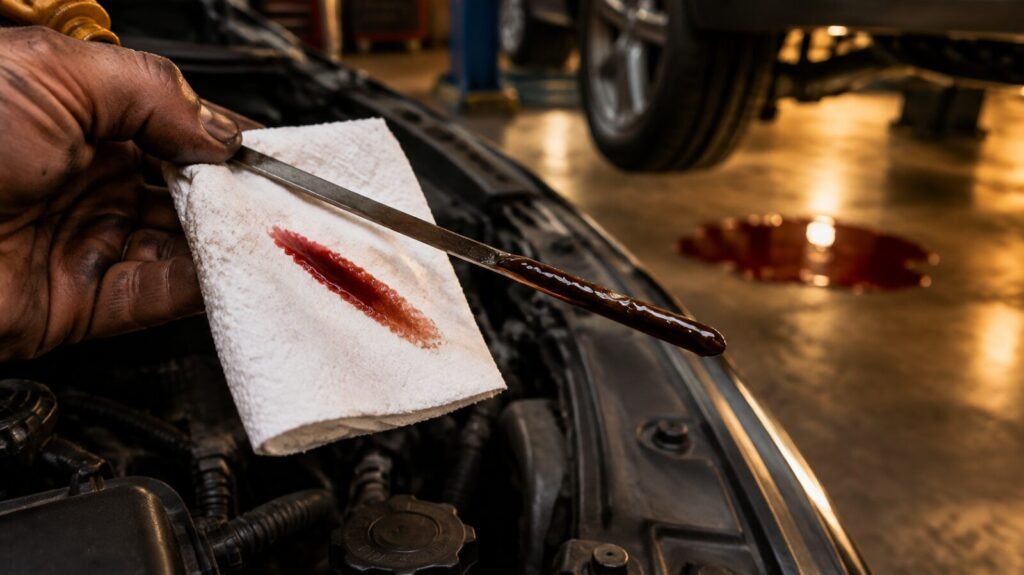
The most common signs of a bad transmission are slipping gears, delayed or rough shifts, a burning smell, red fluid under the car, whining or grinding noises, and a warning light on the dash. Notice any of these? Check the fluid and get a scan within a few days. Caught early, most fixes cost a few hundred dollars. Ignored, they can run into thousands.
Maybe your car felt fine last week. Now it hangs for a second when you shift into Drive, or the engine revs and the car barely moves. It’s easy to shrug that off. Don’t. Transmission trouble almost never fixes itself, and it gets more expensive the longer you drive on it.
At KM Pathway, we source and ship VIN-matched used transmissions to drivers and repair shops across the US. This guide covers automatics, manuals, CVTs and dual-clutch transmissions, because each one fails a little differently.
Key takeaways
| Question | Short answer |
|---|---|
| Most common sign | Slipping or delayed shifting |
| Stop driving right away if… | You smell burning, the car won’t go into gear, or it’s in limp mode |
| First thing to check | Fluid level, color and smell |
| Small repair cost | Usually under $900 |
| Rebuild cost | About $2,000–$3,500 for simpler transmissions |
| Replacement cost | About $6,200–$6,800 national average |
Cost figures: ConsumerAffairs, using RepairPal data, updated October 2026.
What are the 12 signs of a bad transmission?
These 12 symptoms come up again and again in repair guides from AAA and RepairPal. Some are early warnings. Others mean the damage is already done.
1. Slipping gears
You press the gas. The engine revs, but the car doesn’t speed up like it should, almost as if it dropped into neutral for a second. That’s slipping, and it’s one of the clearest signs something is wrong. The usual suspects are low fluid, worn clutch packs or bands, or a failing solenoid. It’s also a safety problem. Losing power halfway through a merge is no joke.
2. A delay when shifting into Drive or Reverse
You move the shifter from Park to Drive and nothing happens for two or three seconds. Then the car lurches forward. A short pause on a freezing morning is normal. A long pause every single time isn’t. Low or old fluid, a clogged filter or worn seals are the common causes.
3. Rough, hard or jerky shifts
A healthy automatic shifts so smoothly you barely feel it. A thud, bang or jerk between gears means something’s off. On newer cars, it’s often a shift solenoid or a software glitch. On older ones, it’s usually worn parts or tired fluid.
4. A burning smell
Smell burnt toast after a drive? The transmission fluid is probably overheating. Once it’s too hot, it stops protecting the parts and friction takes over fast. Pull over, let the car cool down and check the fluid. This one can’t wait.
5. Red fluid under the car
Transmission fluid is usually bright red or pink, though some brands dye it green, yellow or blue. A red puddle near the middle or front of your parking spot usually means a leak from the pan gasket, a cooler line or a seal.
Catch it early and the fix is often cheap. Keep driving with low fluid, and a small leak turns into a big bill.
6. Dark, dirty or low fluid
If your car has a transmission dipstick, pull it. Good fluid is clear red and smells a little sweet. Brown or black fluid, a burnt smell or tiny metal flakes all mean trouble. Plenty of newer cars have sealed transmissions with no dipstick, so a shop will need to check the level for you.
7. Whining, humming or clunking
Listen for a whine that rises with engine speed, a hum in every gear, or a clunk when you shift. Whining often points to low fluid or a worn pump. A clunk can come from worn mounts, U-joints or internal parts. Note exactly when the sound happens. It saves your mechanic real diagnostic time.
8. Grinding gears or a dragging clutch (manuals)
In a manual, grinding usually means a worn clutch or worn synchronizers. If a gear fights you even with the pedal all the way down, the clutch may not be releasing. The good news: a clutch job costs far less than a full rebuild. The bad news: waiting won’t make it cheaper.
9. Check engine or transmission warning light
Modern cars watch the transmission with sensors. When a reading goes out of range, the check engine light comes on. Some cars also show a transmission temperature or “service transmission” message.
A scan tool pulls the stored trouble code in minutes. Transmission codes usually fall in the P0700 to P0799 range. Chains like AutoZone, O’Reilly and Advance Auto Parts generally read codes for free.
10. The car won’t go into gear
You shift into Drive or Reverse and the car doesn’t move, or the shifter won’t budge at all. Sometimes it’s just low fluid or a bad shift cable. Sometimes it’s a failed valve body, torque converter or internal clutch. Either way, don’t drive it until it’s checked.
11. Stuck in one gear (limp mode)
When the computer spots a serious fault, it may lock the car in second or third gear to protect the transmission. That’s limp mode. The car feels sluggish, won’t go fast and revs high on the highway. Treat it as a “get to a shop” signal, not a “keep driving” one.
12. Shuddering at steady speeds
A shake between 30 and 50 mph on a smooth road often points to the torque converter. In CVTs and dual-clutch transmissions, worn fluid can cause it too. A fluid change sometimes helps if it’s done early. Ignore it, and the converter can fail and send debris through the whole transmission.
How urgent is each symptom?
| Symptom | Check first | Urgency |
|---|---|---|
| Burning smell | Fluid level and condition | Stop driving now |
| Won’t go into gear | Fluid level, shift cable | Stop driving now |
| Limp mode | Trouble code scan | Stop driving now |
| Slipping gears | Fluid, solenoids, clutches | Within days |
| Fluid leak | Pan gasket, lines, seals | Within days |
| Shudder at steady speed | Torque converter, fluid | Within days |
| Delayed engagement | Fluid, filter | Within 1–2 weeks |
| Rough or jerky shifts | Solenoid, software, fluid | Within 1–2 weeks |
| Whining or clunking | Fluid, pump, mounts | Within 1–2 weeks |
| Grinding (manual) | Clutch, synchros | Within 1–2 weeks |
| Warning light on | Trouble code scan | Within 1–2 weeks |
| Dark or dirty fluid | Fluid service | Next service visit |
Could it be something other than the transmission?
Yes. Several cheaper problems feel a lot like transmission trouble, so get a proper diagnosis before you pay for a rebuild.
| What you feel | Could also be | How to tell |
|---|---|---|
| Jerking or hesitation when you accelerate | Engine misfire (worn spark plugs or ignition coils) | Misfire codes P0300–P0306, often with a rough idle |
| A clunk when shifting into gear | Worn engine or transmission mounts | A mechanic can see the engine rock as it’s shifted |
| Clicking or clunking on turns | Worn CV joints | Louder on sharp, slow turns |
| A hum that changes with speed, not gear | Bad wheel bearing | Changes when you gently swerve left and right |
| Shaking at highway speed | Unbalanced tires or warped brake rotors | Happens in every gear, or mostly when braking |
If the scan shows no transmission codes and the fluid looks healthy, check these first.
Do automatic, manual, CVT and dual-clutch transmissions fail differently?
Yes. The basic warning signs overlap, but each type has its own usual suspects.
| Transmission type | Most common warning signs | First suspect |
|---|---|---|
| Automatic | Slipping, delayed engagement, harsh shifts, limp mode | Low or burnt fluid, solenoids, worn clutch packs |
| Manual | Grinding, hard shifting, clutch slipping or dragging, popping out of gear | Clutch, synchronizers, linkage |
| CVT | Whining, shudder at low speed, weak acceleration, a “rubber band” feeling | Worn belt or chain, old fluid, overheating |
| Dual-clutch (DCT) | Shudder or hesitation pulling away, rough shifts in stop-and-go traffic | Clutch packs, control unit, software |
CVTs need extra attention. They’re common in newer sedans and crossovers, and they’re often replaced rather than rebuilt. So acting early matters even more.
What causes a transmission to go bad?
Most transmission failures come down to two things: heat and fluid. The fluid cools the parts, keeps them lubricated, and in an automatic it creates the hydraulic pressure that makes shifts happen. Once it runs low or breaks down, wear speeds up fast.
The most common causes:
- Low fluid from a leak nobody noticed for months
- Skipped fluid service, leaving old, burnt fluid that no longer protects anything
- Overheating from towing, hauling heavy loads, or long stretches of stop-and-go traffic
- Hard driving habits, like shifting into Drive while the car is still rolling backward
- Electrical faults in solenoids, sensors or the transmission control module (TCM)
- High mileage, as clutch packs, bands and seals wear out
Most of this is preventable. Service intervals vary a lot by car: some mechanics recommend changing the fluid about every 50,000 miles, while some manufacturers list intervals as long as 150,000 miles (ConsumerAffairs). Go by your owner’s manual, and service it sooner if you tow, haul or spend a lot of time in traffic.
What should you do if you notice these signs?
Act within days, not months. A small fix only stays small if you catch it early.
- Write down when it happens. Cold start, after warm-up, at highway speed, only in Reverse? Details like these help a mechanic find the cause faster.
- Check the fluid. Look at the level, color and smell. If it’s low, find out why before you just top it off.
- Get a diagnostic scan. Trouble codes point straight at solenoid, sensor or pressure problems.
- Check for recalls. Enter your VIN on the NHTSA recalls page. Some transmission problems get fixed for free.
- Talk to a transmission specialist. General shops sometimes suggest a replacement when a cheaper repair would do. A second opinion can save you thousands.
- Get more than one quote, and ask for a line-by-line breakdown.
How much does it cost to fix a transmission?
It depends on your car, the transmission type and where you live. Labor is a big part of the bill: about half of US shops charge $120 to $159 an hour, and rates run from under $100 to over $200 (AAA).
| Repair | Typical cost (USD) |
|---|---|
| Leak inspection | $77 – $113 |
| Fluid flush or service | $119 – $356 |
| Transmission position sensor | $425 – $518 |
| Oil pan gasket replacement | $604 – $855 |
| Solenoid pack (newer transmissions)* | $600 – $700 |
| Rebuild (simpler 4-speed automatic)* | $2,000 – $3,500 |
| Full replacement (national average) | $6,238 – $6,764 |
| Full replacement (range by vehicle) | $3,000 – $15,000+ |
Source: ConsumerAffairs (RepairPal data, updated October 6, 2026). *Rows marked with an asterisk are one mechanic’s estimate quoted in that article.
Should you repair, rebuild or replace?
It depends on what’s actually broken and what the car is worth. Here’s how the options compare:
| Option | Best for | Trade-off |
|---|---|---|
| Minor repair | Early problems: leaks, sensors, solenoids, low fluid | May not fix a deeper root cause |
| Rebuild | Worn internal parts but a sound case, in a car worth keeping | The car is off the road for several days |
| Remanufactured unit | Newer cars, long-term owners | Higher upfront cost, usually a longer warranty |
| Quality used transmission | Older or high-mileage cars where a rebuild doesn’t pencil out | Warranty varies by seller, so check mileage and terms |
| Sell or replace the car | Low-value cars with other big problems | Repair money may be better spent elsewhere |
A useful rule of thumb: if the repair costs more than half of what the car is worth, compare a used or remanufactured transmission against selling the car.
Weighing a used unit against a rebuild? Read our guide to used vs rebuilt transmissions, or get a quote on a VIN-matched used transmission with a 90-day warranty and free shipping to the lower 48.
Transmission terms, explained
| Term | What it means |
|---|---|
| ATF | Automatic transmission fluid. It cools, lubricates and supplies the pressure an automatic needs to shift. |
| Torque converter | A fluid coupling between the engine and an automatic transmission that lets the car idle while in gear. |
| Solenoid | An electrically controlled valve that sends fluid where it’s needed to engage each gear. |
| Valve body | The hydraulic control center that routes fluid through channels to make shifts happen. |
| TCM | Transmission control module, the computer that decides when to shift. |
| Limp mode | A protective mode that locks the car in one gear when the computer detects a serious fault. |
| Synchronizers | Parts in a manual gearbox that match gear speeds so shifts don’t grind. |
| CVT | Continuously variable transmission. It uses a belt or chain instead of fixed gears. |
| DCT | Dual-clutch transmission. It uses two clutches to pre-select the next gear for fast shifts. |
| OBD-II code | A standard trouble code stored by the car’s computer. Transmission codes usually start with P07. |
Frequently asked questions
What is the first sign of a bad transmission?
For most drivers, the first sign is a change in how the car shifts. It might be a short delay going into Drive, a slight slip, or a shift that feels harder than usual. A small red spot under the car is another early clue. Any of these is worth checking now.
Can I keep driving with a bad transmission?
Short trips are sometimes possible, but it’s a gamble. Slipping or limp mode can leave you without power in traffic. Every mile on a failing transmission also adds wear, which can turn a few-hundred-dollar repair into a full replacement. If you smell burning or the car won’t go into gear, stop driving.
Can low transmission fluid cause these symptoms?
Yes. Low fluid is behind a lot of slipping, delayed engagement, whining and overheating. Topping it up may help for a while, but fluid doesn’t just disappear. Something is leaking, and you still need to find and fix that leak before it does real damage to the transmission.
Can a fluid change fix a slipping transmission?
Sometimes, if the slipping comes from low or worn-out fluid and you catch it early. If the clutch packs or bands are already worn, fresh fluid won’t bring them back. On a high-mileage transmission that’s never been serviced, talk to a transmission specialist before changing the fluid.
Is a CVT revving without speeding up always a problem?
Not always. CVTs and some hybrids let the engine rev before the car picks up speed, and that can be completely normal. If the revving gets worse over time, or acceleration clearly drops off, have it checked. That’s when it stops being a quirk and becomes a symptom.
How long does a transmission usually last?
Many transmissions are expected to last 150,000 to 200,000 miles, but real-world life varies a lot by model, driving habits and maintenance. Towing, heavy loads and skipped fluid service all shorten it. Regular fluid service, at the interval in your owner’s manual, is the biggest thing you control.
Does car insurance cover a bad transmission?
Usually not. Car insurance covers damage from accidents, theft or weather, not normal wear and tear. A factory powertrain warranty or an extended warranty might cover it, as long as the failure wasn’t caused by skipped maintenance. Check your warranty terms and keep your service records handy.
How much does it cost to fix a transmission?
Smaller repairs like a sensor, a leak or a fluid service usually cost under $900. A rebuild of a simpler transmission often runs $2,000 to $3,500. A full replacement averages about $6,200 to $6,800 in the US, and it can top $15,000 on some vehicles.
How much does a transmission diagnosis cost?
Reading the trouble code is often free at major auto parts stores. A full diagnostic at a transmission shop costs more, and many shops will credit that fee toward the repair if you go ahead with them. Ask about that before you agree to the diagnosis.
Is it worth fixing early?
Transmission trouble rarely shows up all at once. It starts with one small thing: a slow shift, a new whine, a red spot on the driveway. Catch it there, and you’re usually looking at a few hundred dollars instead of a few thousand.
If your car shows any of these 12 signs, check the fluid, get a scan and talk to a transmission specialist this week. And if a rebuild doesn’t make sense for your car’s age and value, a quality used or remanufactured transmission with a solid warranty can get you back on the road for a lot less.
Disclosure: KM Pathway sells used transmissions. This guide covers every repair option, including ones we don’t sell.
References
- How Much Does a Transmission Cost? — ConsumerAffairs, updated October 6, 2026 (RepairPal data)
- Average Mechanic Labor Rate & Repair Costs in Your State — AAA, 2026
- Vehicle Recalls Lookup — National Highway Traffic Safety Administration
Pingback: Transmission Replacement Cost 2026: Used vs Rebuilt vs New
Pingback: Transmission Slipping: Causes, Symptoms & Fixes (2026)